Single Group Bar Chart
Quick Plot
A bar chart is a commonly used graphical tool for showing numerical comparisons between different categories.
It represents each category using a set of vertical or horizontal rectangular bars, where bar height (or length) corresponds to data magnitude.
Bar charts are intuitive and clear, making them suitable for comparing group means, especially for visualizing discrete categorical data.
In scientific research and data analysis, bar charts are often used to present differences between experimental and control groups.
plotfig is built on the powerful matplotlib, simplifying plotting workflows and making multi-group comparison more straightforward.
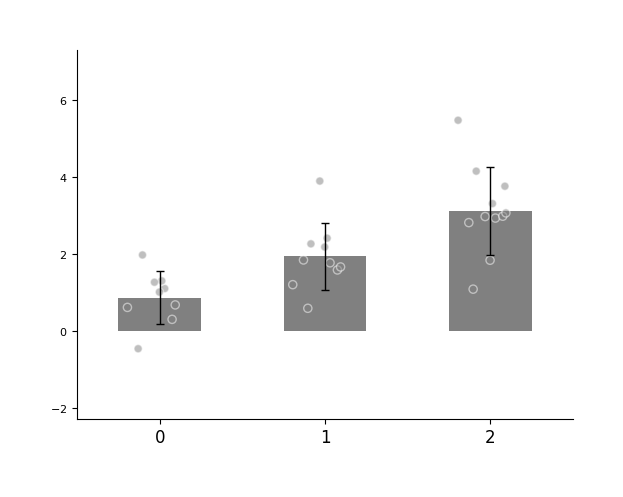
For example, we have 3 groups of data (with 9, 10, and 11 samples respectively), and we use a bar chart to show their differences.
import numpy as np
from plotfig import plot_one_group_bar_figure

data1 = np.random.normal(1, 1, 9)
data2 = np.random.normal(2, 1, 10)
data3 = np.random.normal(3, 1, 11)

ax = plot_one_group_bar_figure([data1, data2, data3])
Multiple Subplots
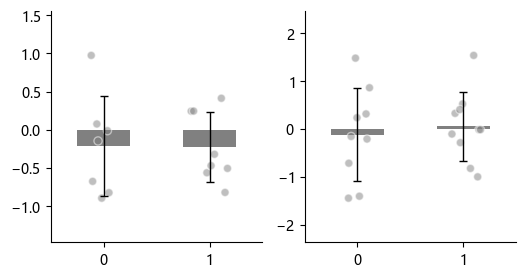
With matplotlib, we can create figure and axes externally in advance, so we can flexibly draw multiple subplots and achieve more complex layouts.
For more advanced subplot layout methods, see the matplotlib tutorial.
import numpy as np
import matplotlib.pyplot as plt
from plotfig import plot_one_group_bar_figure

ax1_bar1 = np.random.normal(0, 1, 7)
ax1_bar2 = np.random.normal(0, 1, 8)
ax2_bar1 = np.random.normal(0, 1, 9)
ax2_bar2 = np.random.normal(0, 1, 10)

fig, axes = plt.subplots(1, 2, figsize=(6, 3))

ax1 = plot_one_group_bar_figure([ax1_bar1, ax1_bar2], ax=axes[0])
ax2 = plot_one_group_bar_figure([ax2_bar1, ax2_bar2], ax=axes[1])
More axes.
import numpy as np
import matplotlib.pyplot as plt
from plotfig import plot_one_group_bar_figure

ax1_bar1 = np.random.normal(3, 1, 7)
ax1_bar2 = np.random.normal(3, 1, 8)
ax2_bar1 = np.random.normal(3, 1, 9)
ax2_bar2 = np.random.normal(3, 1, 10)
ax3_bar1 = np.random.normal(3, 1, 11)
ax3_bar2 = np.random.normal(3, 1, 12)
ax4_bar1 = np.random.normal(3, 1, 13)
ax4_bar2 = np.random.normal(3, 1, 14)


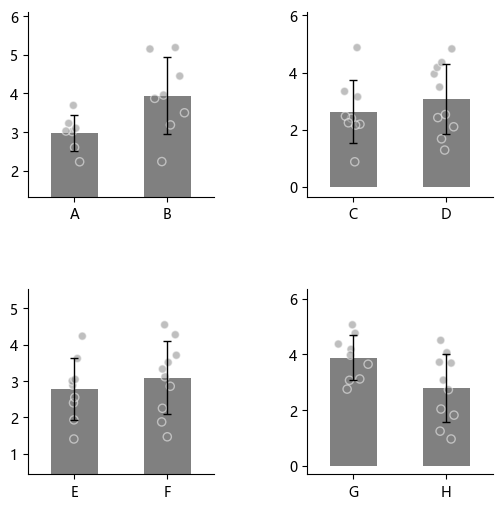
fig, axes = plt.subplots(2, 2, figsize=(6, 6))
fig.subplots_adjust(wspace=0.5, hspace=0.5)

ax1 = plot_one_group_bar_figure([ax1_bar1, ax1_bar2], ax=axes[0,0], labels_name=["A", "B"])
ax2 = plot_one_group_bar_figure([ax2_bar1, ax2_bar2], ax=axes[0,1], labels_name=["C", "D"])
ax3 = plot_one_group_bar_figure([ax3_bar1, ax3_bar2], ax=axes[1,0], labels_name=["E", "F"])
ax4 = plot_one_group_bar_figure([ax4_bar1, ax4_bar2], ax=axes[1,1], labels_name=["G", "H"])
Plot Beautification
Parameter Settings
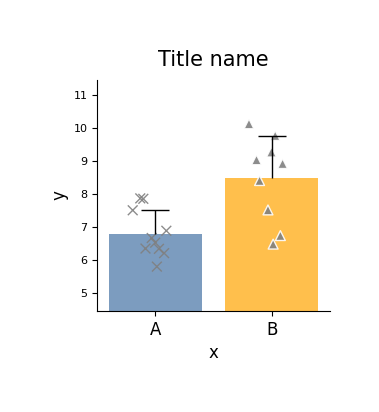
We can create a fig object externally to flexibly control figure size.
plotfig provides rich options for customizing plot styles.
Below is an example showing some commonly used parameters of plot_one_group_bar_figure.
For complete parameter descriptions, see the API documentation for plot_one_group_bar_figure.
import numpy as np
import matplotlib.pyplot as plt
from plotfig import plot_one_group_bar_figure

data1 = np.random.normal(7, 1, 10)
data2 = np.random.normal(8, 1, 9)

fig, ax = plt.subplots(figsize=(3, 3))

ax = plot_one_group_bar_figure(
    [data1, data2],
    ax=ax,
    labels_name=["A", "B"],
    x_label_name="x",
    y_label_name="y",
    title_name="Title name",
    title_fontsize=15,
    width=0.8,
    show_dots=True,
    dots_size=50,
    dots_alpha=0.9,
    dots_markers=["x", "^"],
    colors=["#4573a5", "orange"],
    color_alpha=0.7,
    errorbar_type="sd",
    errorbar_mode="upper",
    errorbar_capsize=10,
)
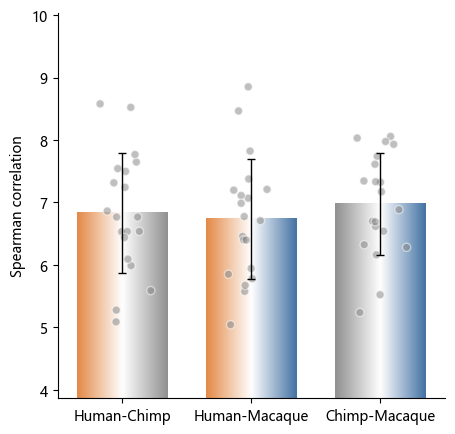
plot_one_group_bar_figure supports rendering bars with gradient colors, which is suitable for showing associations between different objects.
For example, when we compute Pearson correlations of structural connectivity across homologous brain regions (20 in total) among “human-chimpanzee, human-macaque, chimpanzee-macaque,” this style can be used for visualization.
import numpy as np
import matplotlib.pyplot as plt
from plotfig import plot_one_group_bar_figure


human_color = "#e38a48"
chimp_color = "#919191"
macaque_color = "#4573a5"

human_chimp = np.random.random(20)
human_macaque = np.random.random(20)
chimp_macaque = np.random.random(20)

fig, ax = plt.subplots(figsize=(7, 5))

ax = plot_one_group_bar_figure(
    [human_chimp, human_macaque, chimp_macaque],
    ax=ax,
    labels_name=["Human-Chimp", "Human-Macaque", "Chimp-Macaque"],
    y_label_name="Pearson Correlation",
    width=0.7,
    gradient_color=True,
    colors_start=[human_color, human_color, chimp_color],
    colors_end=[chimp_color, macaque_color, macaque_color],
)
About the X Axis
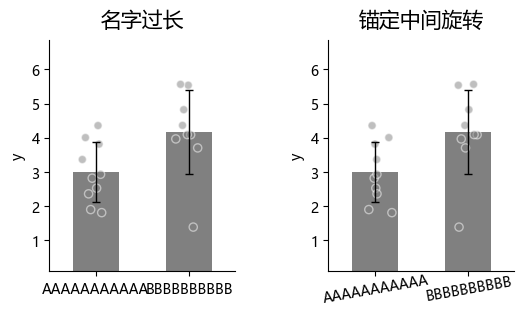
When x-axis labels are long, you can rotate them to avoid overlap and improve readability.
import numpy as np
import matplotlib.pyplot as plt
from plotfig import plot_one_group_bar_figure

data1 = np.random.normal(3, 1, 10)
data2 = np.random.normal(4, 1, 9)

fig, axes = plt.subplots(1, 2, figsize=(6, 3))
fig.subplots_adjust(wspace=0.5)

ax1 = plot_one_group_bar_figure(
    [data1, data2],
    ax=axes[0],
    x_tick_fontsize=10,
    labels_name=["AAAAAAAAAAA", "BBBBBBBBBB"],
    y_label_name="y",
    title_name="Long labels\nwith default rotation",
)
ax2 = plot_one_group_bar_figure(
    [data1, data2],
    ax=axes[1],
    x_tick_fontsize=10,
    labels_name=["AAAAAAAAAAA", "BBBBBBBBBB"],
    y_label_name="y",
    title_name="Long labels\nwith custom rotation",
    x_tick_rotation=10,
    x_label_ha="center",
)
About the Y Axis
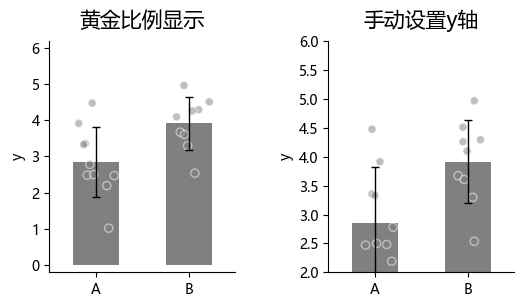
By default, plot_one_group_bar_figure automatically computes the distance between the highest and lowest points and sets it to 0.618 (the golden ratio) of the y-axis span to optimize visual appearance.
If you want to manually set the y-axis range, you can use y_lim.
import numpy as np
import matplotlib.pyplot as plt
from plotfig import plot_one_group_bar_figure

data1 = np.random.normal(3, 1, 10)
data2 = np.random.normal(4, 1, 9)

fig, axes = plt.subplots(1, 2, figsize=(6, 3))
fig.subplots_adjust(wspace=0.5)

ax1 = plot_one_group_bar_figure(
    [data1, data2],
    ax=axes[0],
    labels_name=["A", "B"],
    y_label_name="y",
    title_name="Golden ratio",
)
ax2 = plot_one_group_bar_figure(
    [data1, data2],
    ax=axes[1],
    labels_name=["A", "B"],
    y_label_name="y",
    title_name="Custom y-axis limit",
    y_lim=(2, 6)
)
Sometimes we want to fix the bottom of the axis at 0, but we are not sure about the exact maximum tick value. In that case, use ax_bottom_is_0.
import numpy as np
import matplotlib.pyplot as plt
from plotfig import plot_one_group_bar_figure

data1 = np.random.normal(1,  1, 10)
data2 = np.random.normal(2, 1, 9)

fig, axes = plt.subplots(1, 2, figsize=(6, 3))
fig.subplots_adjust(wspace=0.5)

ax1 = plot_one_group_bar_figure(
    [data1, data2],
    ax=axes[0],
    labels_name=["A", "B"],
    y_label_name="y",
    title_name="Golden ratio",
)
ax2 = plot_one_group_bar_figure(
    [data1, data2],
    ax=axes[1],
    labels_name=["A", "B"],
    y_label_name="y",
    title_name="No negative values",
    ax_bottom_is_0=True,
)
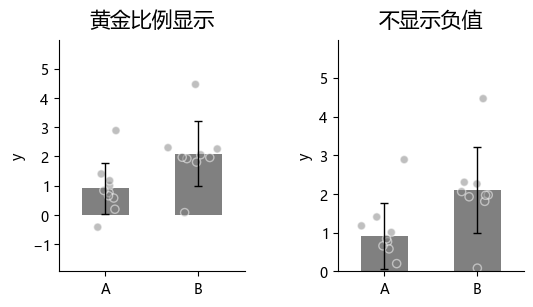
Sometimes we want to constrain the maximum y-axis tick to 1. For example, when the y-axis represents Fisher z-transformed correlation coefficients, you can set y_max_tick_is_1 to force the maximum y-axis tick to 1.
import numpy as np
import matplotlib.pyplot as plt
from plotfig import plot_one_group_bar_figure

data1 = np.random.normal(0.9, 0.1, 10)
data2 = np.random.normal(0.9, 0.1, 9)

fig, axes = plt.subplots(1, 2, figsize=(6, 3))
fig.subplots_adjust(wspace=0.5)

ax1 = plot_one_group_bar_figure(
    [data1, data2],
    ax=axes[0],
    labels_name=["A", "B"],
    y_label_name="y",
    title_name="Golden ratio",
)
ax2 = plot_one_group_bar_figure(
    [data1, data2],
    ax=axes[1],
    labels_name=["A", "B"],
    y_label_name="y",
    title_name="y-axis max tick is 1",
    y_max_tick_is_1=True,
)
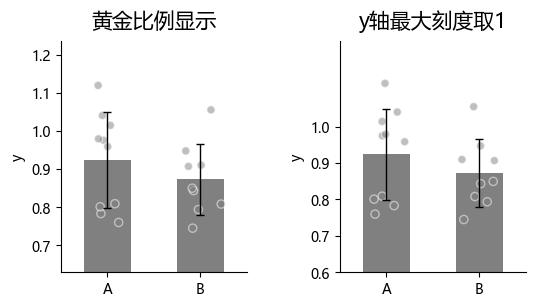
Sometimes we may want to change y-axis number formatting, for example using scientific notation. You can control this with math_text.
import numpy as np
import matplotlib.pyplot as plt
from plotfig import plot_one_group_bar_figure

data1 = np.random.normal(10000, 1000, 10)
data2 = np.random.normal(11000, 1000, 9)
data3 = np.random.normal(0.0001, 0.0001, 11)
data4 = np.random.normal(0.001, 0.0001, 12)

fig, axes = plt.subplots(2, 2, figsize=(6, 6))
fig.subplots_adjust(wspace=0.5, hspace=0.5)

ax1 = plot_one_group_bar_figure(
    [data1, data2],
    ax=axes[0,0],
    labels_name=["A", "B"],
    y_label_name="y",
    title_name="Scientific notation",
)
ax2 = plot_one_group_bar_figure(
    [data1, data2],
    ax=axes[0,1],
    labels_name=["A", "B"],
    y_label_name="y",
    title_name="No scientific notation",
    math_text=False,
)
ax3 = plot_one_group_bar_figure(
    [data3, data4],
    ax=axes[1,0],
    labels_name=["A", "B"],
    y_label_name="y",
    title_name="Scientific notation",
)
ax4 = plot_one_group_bar_figure(
    [data3, data4],
    ax=axes[1,1],
    labels_name=["A", "B"],
    y_label_name="y",
    title_name="No scientific notation",
    math_text=False,
)
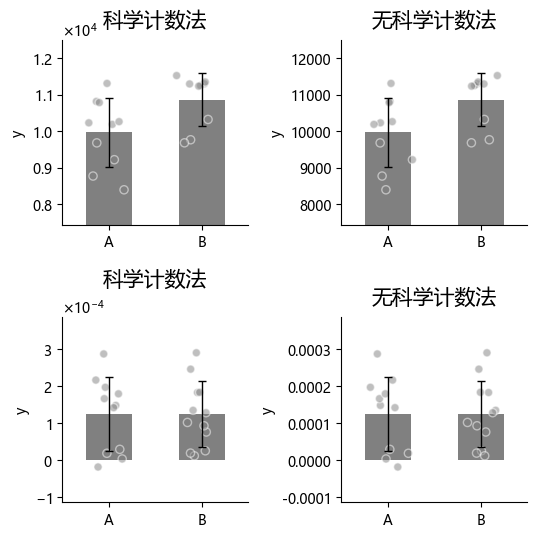
Sometimes we want to display the Y axis in percentage format.
Warning
percentage format conflicts with math_text.
Since math_text is enabled by default, you need to explicitly disable it.
import numpy as np
import matplotlib.pyplot as plt
from plotfig import plot_one_group_bar_figure

data1 = np.random.normal(0.5,  0.1, 10)
data2 = np.random.normal(0.5, 0.1, 9)

fig, axes = plt.subplots(1, 2, figsize=(6, 3))
fig.subplots_adjust(wspace=0.5)

ax1 = plot_one_group_bar_figure(
    [data1, data2],
    ax=axes[0],
    labels_name=["A", "B"],
    y_label_name="y",
    title_name="Default",
)
ax2 = plot_one_group_bar_figure(
    [data1, data2],
    ax=axes[1],
    labels_name=["A", "B"],
    y_label_name="y",
    title_name="Show percentages",
    math_text=False,
    percentage=True,
)
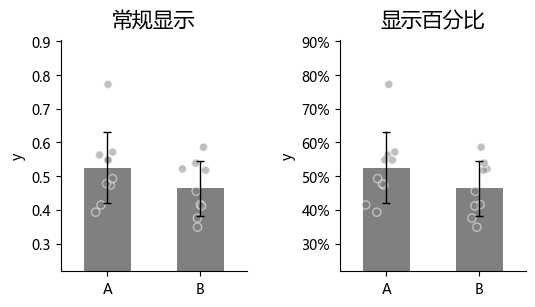
About Scatter Points
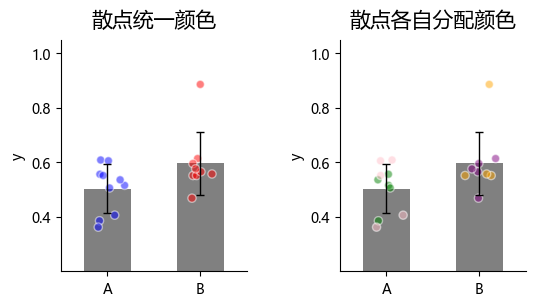
plot_one_group_bar_figure allows assigning colors to each scatter point, which can be used to distinguish data from different sources.
import numpy as np
import matplotlib.pyplot as plt
from plotfig import plot_one_group_bar_figure

data1 = np.random.normal(0.5,  0.1, 10)
data2 = np.random.normal(0.5, 0.1, 9)

dots_color1 = [["blue"]*10, ["red"]*9]
dots_color2 = [["green"]*5+["pink"]*5, ["orange"]*4+["purple"]*5]

fig, axes = plt.subplots(1, 2, figsize=(6, 3))
fig.subplots_adjust(wspace=0.5)

ax1 = plot_one_group_bar_figure(
    [data1, data2],
    ax=axes[0],
    labels_name=["A", "B"],
    y_label_name="y",
    title_name="Scatter points\nwith the same color",
    dots_color=dots_color1,  # scatter point colors
)
ax2 = plot_one_group_bar_figure(
    [data1, data2],
    ax=axes[1],
    labels_name=["A", "B"],
    y_label_name="y",
    title_name="Scatter points\nwith different colors",
    dots_color=dots_color2,
)
Statistics
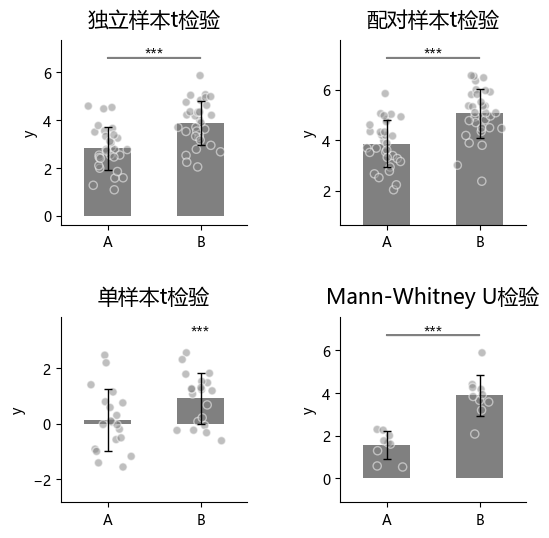
plot_one_group_bar_figure can quickly perform between-bar statistical comparison. Currently supported methods are:
- Independent-samples t-test (
ttest_ind) - Paired-samples t-test (
ttest_rel) - One-sample t-test (
ttest_1samp) - Mann-Whitney U test (
mannwhitneyu) - External statistical test (
external)
To use statistics, first enable it via statistic, then specify method names in test_method.
import numpy as np
import matplotlib.pyplot as plt
from plotfig import plot_one_group_bar_figure

np.random.seed(42)

data1 = np.random.normal(3, 1, 30)
data2 = np.random.normal(4, 1, 31)
data3 = np.random.normal(5, 1, 31)
data4 = np.random.normal(2, 1, 9)
data5 = np.random.normal(4, 1, 10)

fig, axes = plt.subplots(2, 2, figsize=(6, 6))
fig.subplots_adjust(wspace=0.5, hspace=0.5)

ax1 = plot_one_group_bar_figure(
    [data1, data2],
    ax=axes[0,0],
    labels_name=["A", "B"],
    y_label_name="y",
    title_name="Independent samples t-test",
    statistic=True,
    test_method=["ttest_ind"]
)
ax2 = plot_one_group_bar_figure(
    [data2, data3],
    ax=axes[0,1],
    labels_name=["A", "B"],
    y_label_name="y",
    title_name="Paired samples t-test",
    statistic=True,
    test_method=["ttest_rel"]
)
ax3 = plot_one_group_bar_figure(
    [data1, data2],
    ax=axes[1,0],
    labels_name=["A", "B"],
    y_label_name="y",
    title_name="One-sample t-test",
    statistic=True,
    test_method=["ttest_1samp"],
    popmean=3,
)
ax4 = plot_one_group_bar_figure(
    [data4, data5],
    ax=axes[1,1],
    labels_name=["A", "B"],
    y_label_name="y",
    title_name="Mann-Whitney U test",
    statistic=True,
    test_method=["mannwhitneyu"]
)
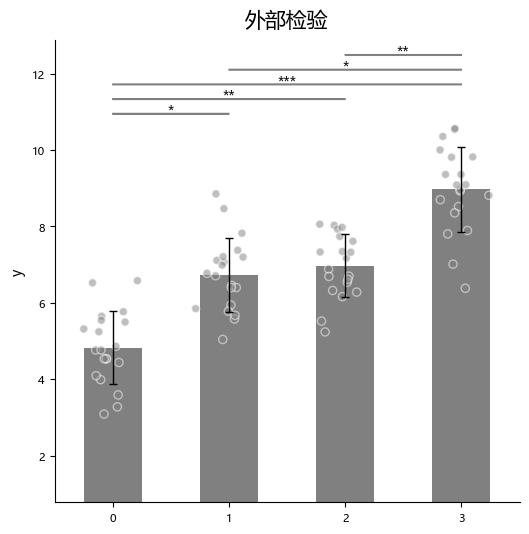
“External statistical test” (external) means users can run tests in other statistical software and only pass the resulting p-values into this function.
For external tests, you additionally pass the corresponding p-value list via p_list.
Note
When using “external statistical test” with multiple bars to compare, the input p values should follow this order:
- 1 -> 2, 1 -> 3, ..., 1 -> n
- 2 -> 3, 2 -> 4, ..., 2 -> n
- and so on
import numpy as np
import matplotlib.pyplot as plt
from plotfig import plot_one_group_bar_figure

np.random.seed(42)

data1 = np.random.normal(5,  1, 20)
data2 = np.random.normal(7, 1, 20)
data3 = np.random.normal(7, 1, 20)
data4 = np.random.normal(9, 1, 20)

p_list = [0.05, 0.01, 0.001, 1, 0.05, 0.01]

fig, ax = plt.subplots(figsize=(6, 6))

ax = plot_one_group_bar_figure(
    [data1, data2, data3, data4],
    ax=ax,
    y_label_name="y",
    title_name="External test",
    statistic=True,
    test_method=["external"],
    p_list=p_list,
)
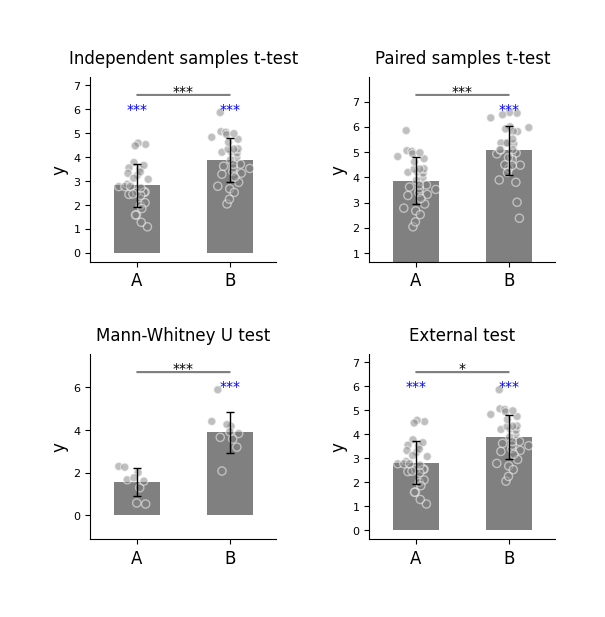
The following 4 tests can each be executed together with the one-sample t-test ttest_1samp:
1. Independent-samples t-test (ttest_ind)
2. Paired-samples t-test (ttest_rel)
3. Mann-Whitney U test (mannwhitneyu)
4. External statistical test (external)
That is, two tests are run in the same subplot.
import numpy as np
import matplotlib.pyplot as plt
from plotfig import plot_one_group_bar_figure

np.random.seed(42)

data1 = np.random.normal(3, 1, 30)
data2 = np.random.normal(4, 1, 31)
data3 = np.random.normal(5, 1, 31)
data4 = np.random.normal(2, 1, 9)
data5 = np.random.normal(4, 1, 10)

fig, axes = plt.subplots(2, 2, figsize=(6, 6))
fig.subplots_adjust(wspace=0.5, hspace=0.5)

ax1 = plot_one_group_bar_figure(
    [data1, data2],
    ax=axes[0,0],
    labels_name=["A", "B"],
    y_label_name="y",
    title_name="Independent samples t-test",
    statistic=True,
    test_method=["ttest_ind", "ttest_1samp"],
    popmean=0
)
ax2 = plot_one_group_bar_figure(
    [data2, data3],
    ax=axes[0,1],
    labels_name=["A", "B"],
    y_label_name="y",
    title_name="Paired samples t-test",
    statistic=True,
    test_method=["ttest_rel", "ttest_1samp"],
    popmean=4,
)
ax3 = plot_one_group_bar_figure(
    [data4, data5],
    ax=axes[1,0],
    labels_name=["A", "B"],
    y_label_name="y",
    title_name="Mann-Whitney U test",
    statistic=True,
    test_method=["mannwhitneyu", "ttest_1samp"],
    popmean=2,
)
ax4 = plot_one_group_bar_figure(
    [data1, data2],
    ax=axes[1,1],
    labels_name=["A", "B"],
    y_label_name="y",
    title_name="External test",
    statistic=True,
    test_method=["external", "ttest_1samp"],
    p_list=[0.05],
    popmean=0,
)
Single Group Box Plot and Violin Plot
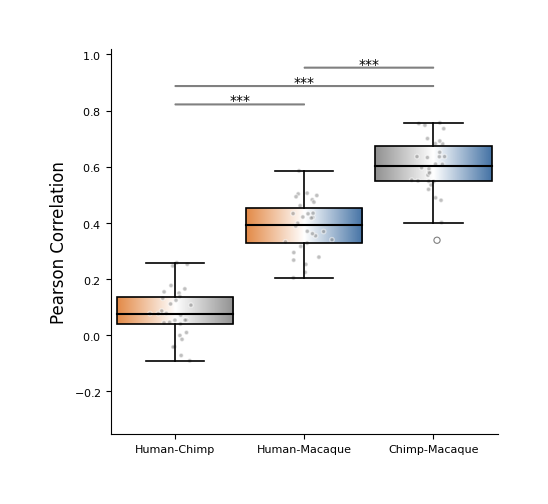
A box plot is a standard statistical chart for displaying the characteristics of data distribution. It intuitively presents the median, interquartile range (IQR), and outlier range through the "box" and "whiskers."
In a box plot, the upper and lower boundaries of the box represent the third quartile (Q3) and first quartile (Q1), respectively. The white line inside the box marks the median (with an optional diamond for the mean), and the upper and lower whiskers extend to the furthest data points within the non-outlier range. Points beyond the whiskers are plotted individually as outliers.
Box plots focus on robust statistics without relying on distributional assumptions, making them suitable for comparing central tendency and dispersion across multiple groups — especially with large sample sizes or when outliers are present.
In plotfig, the function for drawing box plots is plot_one_group_box_figure. Most of its parameters are similar to plot_one_group_bar_figure; below is a partial demonstration.
For complete parameter descriptions, see the API documentation for plot_one_group_box_figure.
import numpy as np
import matplotlib.pyplot as plt
from plotfig import plot_one_group_box_figure

human_color = "#e38a48"
chimp_color = "#919191"
macaque_color = "#4573a5"

np.random.seed(42)

human_chimp = 0.1 + np.random.normal(0, 0.1, 30)
human_macaque = 0.4 + np.random.normal(0, 0.1, 30)
chimp_macaque = 0.6 + np.random.normal(0, 0.1, 30)

fig, ax = plt.subplots(figsize=(5,5))

ax = plot_one_group_box_figure(
    [human_chimp, human_macaque, chimp_macaque],
    ax=ax,
    labels_name=["Human-Chimp", "Human-Macaque", "Chimp-Macaque"],
    x_tick_fontsize=8,
    y_label_name="Pearson Correlation",
    width=0.9,
    show_dots=True,
    dots_size=10,
    gradient_color=True,
    colors_start= [human_color, human_color, chimp_color],
    colors_end= [chimp_color, macaque_color, macaque_color],
    statistic=True,
    test_method=["mannwhitneyu"]
)
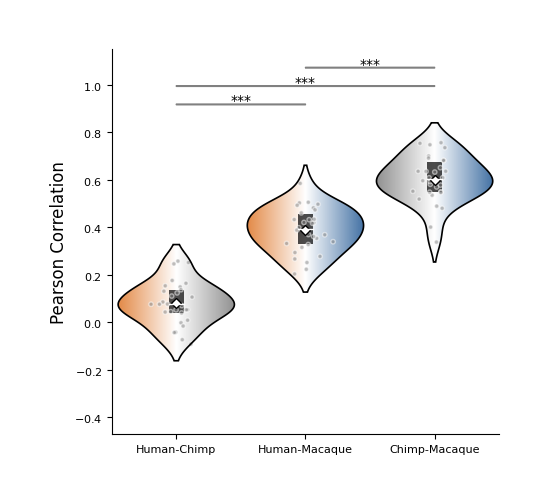
A violin plot is a visualization tool that combines characteristics of a box plot and a density plot, used to show data distributions. It not only shows statistical information such as mean (white diamond), median (white line), and quartiles (black rectangle), but also reflects distribution shape across value ranges through symmetric kernel density curves.
Compared with traditional box plots, violin plots can reveal multimodality and skewness more comprehensively, and are suitable for comparing distribution differences across groups. When data are unevenly distributed and non-parametric methods are used, violin plots are often more appropriate.
In plotfig, the function for drawing violin plots is plot_one_group_violin_figure.
Most of its parameters are similar to plot_one_group_bar_figure; below is a partial demonstration.
For complete parameter descriptions, see the API documentation for plot_one_group_violin_figure.
import numpy as np
import matplotlib.pyplot as plt
from plotfig import plot_one_group_violin_figure

human_color = "#e38a48"
chimp_color = "#919191"
macaque_color = "#4573a5"

np.random.seed(42)

human_chimp = 0.1 + np.random.normal(0, 0.1, 30)
human_macaque = 0.4 + np.random.normal(0, 0.1, 30)
chimp_macaque = 0.6 + np.random.normal(0, 0.1, 30)

fig, ax = plt.subplots(figsize=(5,5))

ax = plot_one_group_violin_figure(
    [human_chimp, human_macaque, chimp_macaque],
    ax=ax,
    labels_name=["Human-Chimp", "Human-Macaque", "Chimp-Macaque"],
    y_label_name="Pearson Correlation",
    width=0.9,
    show_dots=True,
    dots_size=10,
    gradient_color=True,
    colors_start= [human_color, human_color, chimp_color],
    colors_end= [chimp_color, macaque_color, macaque_color],
    statistic=True,
    test_method=["mannwhitneyu"]
)